How it works
Four questions decide the method, before a frame is scanned.
16mm is a professional gauge and it does not behave like home movie film. Getting these wrong produces a scan that technically works and quietly loses what mattered.
Read the edges before opening anything.
Silent 16mm is usually double perforated, with sprocket holes on both edges. Sound 16mm is single perforated, because the track occupies the edge where the second row of holes used to be. That is often the fastest way to tell what you have.
An optical track is printed photographically and read as light. A magnetic stripe is a band of oxide read as tape. They need different capture paths, and a lab that assumes one will silently miss the other.
What we establish first
1 · What element is this?
Camera original, print, or reversal. Original carries the most information and the most risk, because there is no backup behind it. The right scan settings differ for each, and so does how carefully it gets threaded.
2 · Is there sound, and of what kind?
Optical or magnetic, and which one decides the capture path. The perforations usually tell you before anything is opened. Silent stock rarely carries either.
3 · How much has it shrunk?
Acetate loses dimension as it ages. Past a point the sprocket holes no longer align with the transport, and forcing it tears the film. Shrinkage is measured, not eyeballed.
4 · Is it on a core or a reel?
Archival material often arrives wound on cores, which is how it should be stored and not how it can be handled casually. Cores need winding onto a reel first, and rushing that step is where damage happens.
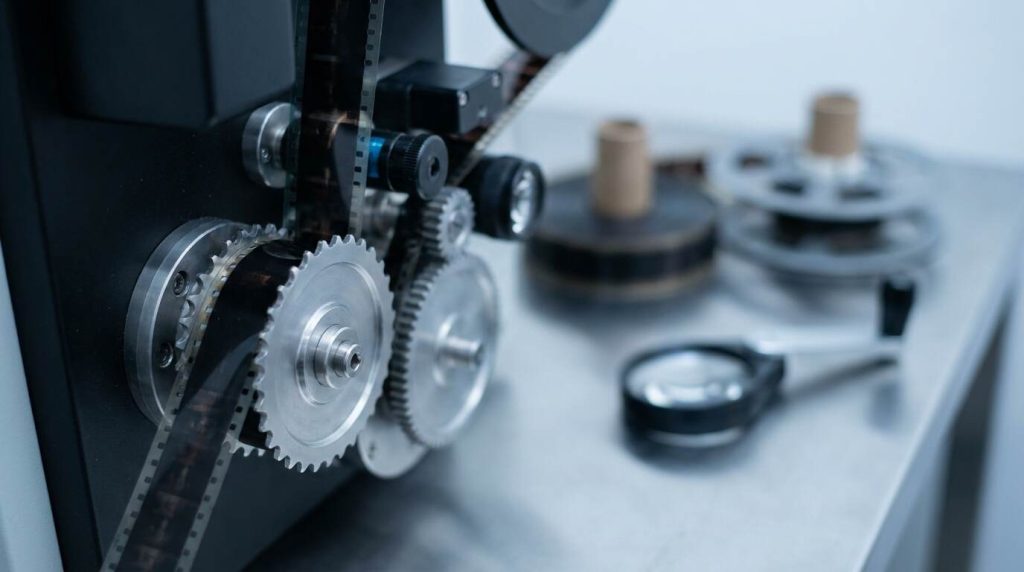
Then, scanning, frame by frame.
Each frame is captured as a separate image on Motion Picture Academy grade equipment, at true HD 1080p minimum and up to 2K. Not a projector pointed at a screen, which loses frame edges and introduces flicker no amount of correction removes.
Files come back on a flash or hard drive, with your originals in the same shipment. For a catalogued collection we match a file naming and format specification you supply.
Not sure what you are holding?
Send a photo and a rough count. We will tell you what it is and what it would involve, with no obligation.