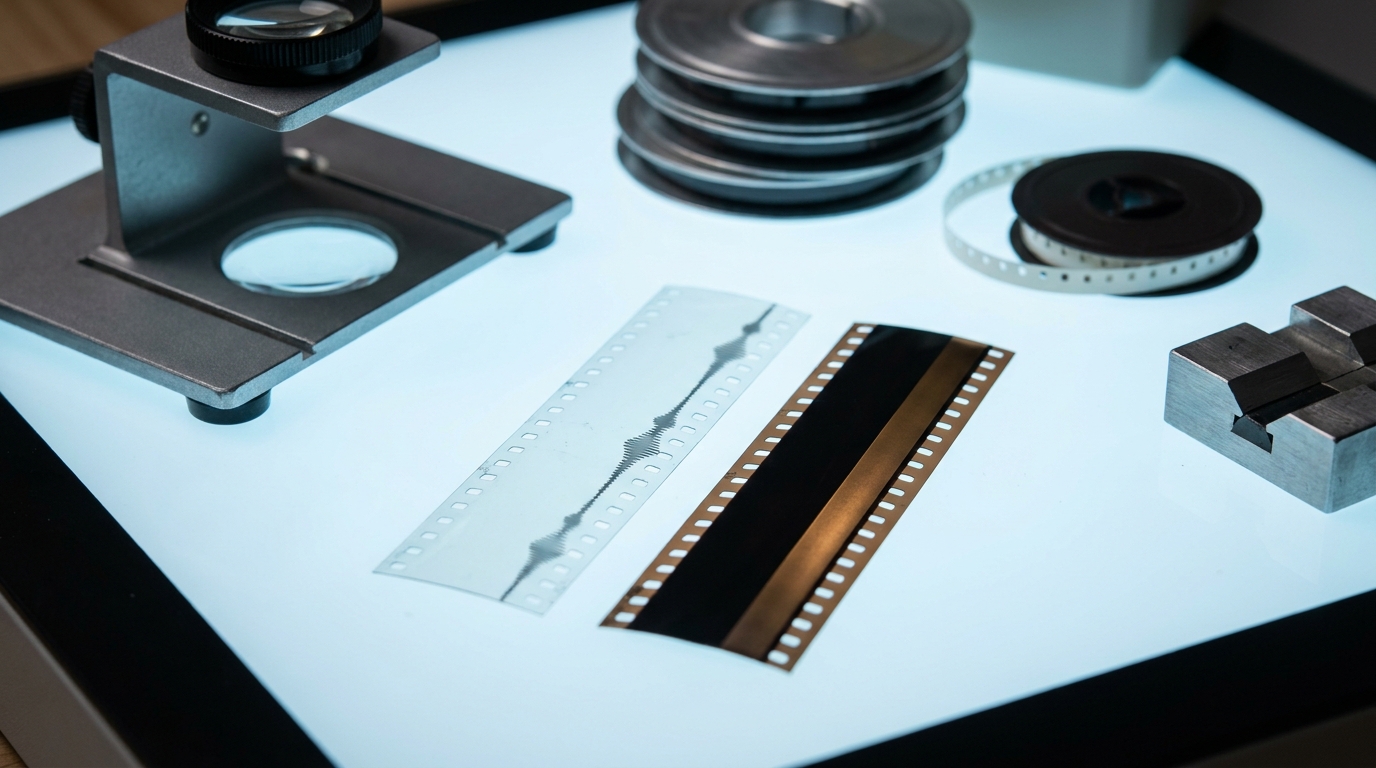
Look at the edge opposite the sprocket holes. A translucent printed pattern – jagged sawtooth or grey horizontal bands – is an optical track, an image of the sound read by light. A dull brown or bronze band with perceptible thickness, usually paired with a thinner balance stripe on the perforated edge, is magnetic: a coating that must be physically touched by a playback head to be read. That single mechanical difference decides whether your sound can come off the scan itself or requires the film to survive a real-time contacting pass at speed.
- Optical is an image, so it can be extracted from the scanned frames without running the film at 24 fps.
- Magnetic has no image. It needs contact, controlled speed, and film flat enough to stay against the head.
- Double-perf 16mm has no room for a track. If the can promises narration, the sound lived elsewhere.
- A magnetic reel in perfect visual condition can still be silent – contact tolerance is tighter than optical tolerance.
The belief most people arrive with
Most enquiries treat sound film as one category, with the lab expected to “just get the sound.” It is not one category. Optical and magnetic are two unrelated physical technologies that happen to share a strip of film, and a facility can be properly equipped for one and not the other.
The second assumption is more expensive: that if the picture looks fine, the sound is fine. On magnetic stripe that is often untrue. The oxide layer ages on its own schedule, independent of the emulsion carrying the image.
How optical sound actually works
An optical track is a photographic record. The soundtrack is exposed onto the film, developed alongside the picture, and read back by shining a narrow beam through the moving track onto a photocell. Variations in the pattern’s area or density modulate the light, and the photocell turns that into voltage.
Two families exist. Variable area looks like a jagged sawtooth or symmetrical zigzag and is what most 16mm holders encounter. Variable density looks like horizontal bands of varying greyness. Both are read the same way.
Because the track is part of the photographic image, anything that damages the emulsion damages the sound. Lengthwise scratches through the track produce ticks and hiss. Heavy base scratches in the track area produce a persistent buzz. Dirt reads as crackle, because the reader cannot distinguish grime from signal.
How magnetic sound actually works
Magnetic sound on 16mm is a stripe of magnetic oxide applied to the film after processing, along the edge opposite the perforations, with a thinner balance stripe on the perforated edge so the reel winds flat. It is recorded and read exactly as audio tape is, by a head that must physically touch it.
That contact requirement is the whole story. Curl, cupping, a proud splice, shrinkage that alters the film’s path – anything that lifts the stripe away from the head produces dropouts. The head cannot read across a gap.
Striped 16mm arrives in two guises that are easy to confuse. Some prints were struck with a stripe and recorded at a lab, so another copy may exist. Others are camera-original reversal striped afterwards so the shooter could lay narration or wild sound. The second kind is frequently the only copy in existence, and it is where a shedding stripe means genuinely unrecoverable audio rather than an inconvenience.
Identifying which one you have, without a projector
You do not need to thread anything. Unwind two feet on a light table or against a window, perforations to your left, and look at the right-hand edge.
- Translucent, with a printed pattern you can see light through: optical.
- Opaque, matte, brown or bronze rather than image-coloured: magnetic.
- Run a fingertip lightly across both edges. A stripe has perceptible thickness. An optical track does not.
- Look for a second, narrower dull band on the perforated edge. That balance stripe confirms magnetic.
- Perforations on both edges and no visible track: silent, regardless of what the can says.
That last check catches a surprising number of collections. If a can is labelled with a running time and a narrator’s name but the film is double-perf, the sound lived on separate magnetic full-coat or a disc. It is either in the same box or it is gone.
Where condition and sound type part company
Shrinkage is the sharpest divide. A shrunken print pulls its perforations out of register and rides differently in the gate. For optical sound extracted from the scan that is manageable, because the scanner registers to the perforation or the image and the track comes along with the frame.
For magnetic it is a harder problem, and there is a point where we stop. Past roughly 1% shrinkage on a striped reel we will not attempt a real-time magnetic pass, because the transport tension needed to hold the stripe against the head is tension the perforations can no longer take. The choice at that point is honest silence or a torn original, and we do not run that risk on a unique reel.
Vinegar syndrome compounds it. Acetate decay produces shrinkage, buckling and eventually a rigid, warped reel. On a striped acetate print the picture and the sound decay by the same mechanism, but the sound fails first, because contact tolerance is much tighter than optical tolerance.
What shedding actually sounds like
Roughly one striped reel in five that reaches our bench is shedding to some degree – oxide dusting the rewind arm, or visible bare patches where the coating has let go of the base. Once the oxide has left the film, the information it carried is gone. There is nothing left to read.
One example, anonymised: a 1970s striped reversal original, church-held, single copy, stripe intact for the first two thirds and failing intermittently thereafter. We recovered continuous narration up to that point, then the audio dropped to a flat, silent hole for one to three seconds at a time before returning mid-word. Not noise, not distortion – absence, as if someone were pressing mute. The client got a usable record of most of the recording and an honest map of the gaps. That is the realistic best case with a shedding stripe, and it is worth knowing before the invoice rather than after.
| Attribute | Optical | Magnetic |
|---|---|---|
| Physical form | Photographic pattern in the emulsion | Oxide stripe applied on top of the base |
| Read by | Light and photocell, or extracted from the scan | Head in physical contact with the stripe |
| Real-time pass required | Not necessarily | Yes |
| Main failure mode | Scratches, dirt, emulsion damage in the track area | Shedding oxide, de-bonding, dropouts from poor contact |
| Typical origin | Release prints, distribution copies | Striped originals, news and instructional reels, narration masters |
What to ask a lab before you send anything
Do you read magnetic at all?
Many scanning services handle optical only, because it falls out of the image capture at no extra effort. Ask directly. “We do sound” is not an answer.
How do you extract optical?
From the scanned frames, or from a separate real-time optical reader? Both are legitimate. The first is gentler on fragile film.
At what shrinkage do you stop?
A lab with a stated threshold has thought about the tradeoff. A lab without one is deciding on your reel, in the moment, with your original in the gate.
On billing mechanics, ask which model applies before you count anything. Some facilities charge sound as a flat per-reel surcharge, which makes a 200 foot reel and an 800 foot reel of the same content identical line items. Others fold it into a per-foot rate that tracks actual material. Neither is wrong, but a collection of many short reels and one of a few long ones come out very differently depending on the mechanic you are quoted under.
- Working in our own Southern California lab since 2001
- More than 125,000 reels of film transferred without losing a single item
- Your originals are handled in-house and returned with every order
- Family owned and operated since 2001
- Work used by CBS, ABC, Disney Animation, Paramount and Sony
The line worth remembering
Optical sound is an image and can be recovered from the scan itself; magnetic sound is a physical coating that must be touched to be read, which is why a magnetic reel in perfect visual condition can still be silent.
If the reel in your hands is a striped original, it is the only one, and it is decaying on a clock nobody controls. The useful next step is not a quote request but a condition assessment: measure the shrinkage and look at the stripe before deciding what a transfer can honestly deliver.
Frequently asked questions
How do I tell if my 16mm film has sound at all?
Check the perforations. Double-perf 16mm, with sprocket holes on both edges, has no room for a track and is silent, whatever the label claims. Single-perf film has one row and an open edge where a track may live. If that open edge is blank, the film is silent single-perf, which is common for camera original.
Can you get sound off a magnetic stripe that is flaking?
Sometimes partially, sometimes not at all. Where the oxide has left the base the information is gone. What can be done is recovering the intact stretches and documenting the gaps honestly – typically silent holes of a second or two rather than noise. Any lab promising full recovery from a shedding stripe it has not seen is guessing.
Is optical sound on 16mm always poor quality?
No, though calibrate expectations. 16mm optical tracks are narrower than their 35mm equivalents and carry less bandwidth, so they sound band-limited beside a healthy magnetic original. But a clean optical track on an undamaged print is perfectly intelligible and often better than the same content on a badly aged stripe. Condition matters more than format.
Does a 4K scan improve the sound?
For optical, more resolution across the track area can help the extraction, because the reader resolves a finer pattern. For magnetic it makes no difference whatsoever, since the audio never passes through the imaging path. Choose scan resolution on picture grounds.
My film is on a core, not a reel. Does that affect sound transfer?
Not directly, but it is a signal. Core-wound film usually came from a lab or archive rather than a projection room, so it is more likely a print master or camera original than a worn release print. It also has to be wound onto a reel or handled on the bench before any real-time magnetic pass, which is an extra handling step worth knowing in advance.
What if the picture is 16mm but the sound was on a separate reel?
That is magnetic full-coat or a separate audio element, common on edited productions. Sync then depends on a sync point, usually a slate or a punched frame at head. If the audio element is missing, the picture reel is silent and no amount of scanning changes that. Go through the whole box before concluding it is lost.